

Space Propellant Tank Market 2026: Enable Next-Generation Space Exploration With Advanced Fuel Storage Systems
Space Propellant Tank Market Growth

Space Propellant Tank Market Size
Space Propellant Tank Market Report
The Business Research Company’s Space Propellant Tank Global Market Report 2026 - Market Size, Trends, And Global Forecast 2026-2035
LONDON, GREATER LONDON, UNITED KINGDOM, March 9, 2026 /EINPresswire.com/ -- Space Propellant Tank Market to Surpass $5 billion in 2030. In comparison, the Aerospace Support and Auxiliary Equipment which is considered as its parent market, is expected to be approximately $42 billion by 2030, with Space Propellant Tank market to represent around 12% of the parent market. Within the broader Aerospace & Defense industry, which is expected to be $1,102 billion by 2030, the Space Propellant Tank market is estimated to account for nearly 0.5% of the total market value.
Which Will Be the Biggest Region in the Space Propellant Tank Market in 2030
North America will be the largest region in the space propellant tank market in 2030, valued at $2,729 million. The market is expected to grow from $2,041 million in 2025 at a compound annual growth rate (CAGR) of 6%. The strong growth can be attributed to the growth in space tourism and increasing number of satellites launches.
Which Will Be The Largest Country In The Space Propellant Tank Market In 2030?
The USA will be the largest country in the space propellant tank market in 2030, valued at $2,434 million. The market is expected to grow from $1,843 million in 2025 at a compound annual growth rate (CAGR) of 6%. The strong growth can be attributed to the rising defense spending in space programs and growth in space tourism.
Request a free sample of the Space Propellant Tank report:
https://www.thebusinessresearchcompany.com/sample_request?id=23853&type=smp&utm_source=EINPresswire&utm_medium=Paid&utm_campaign=Mar_PR
What will be Largest Segment in the Space Propellant Tank Market in 2030?
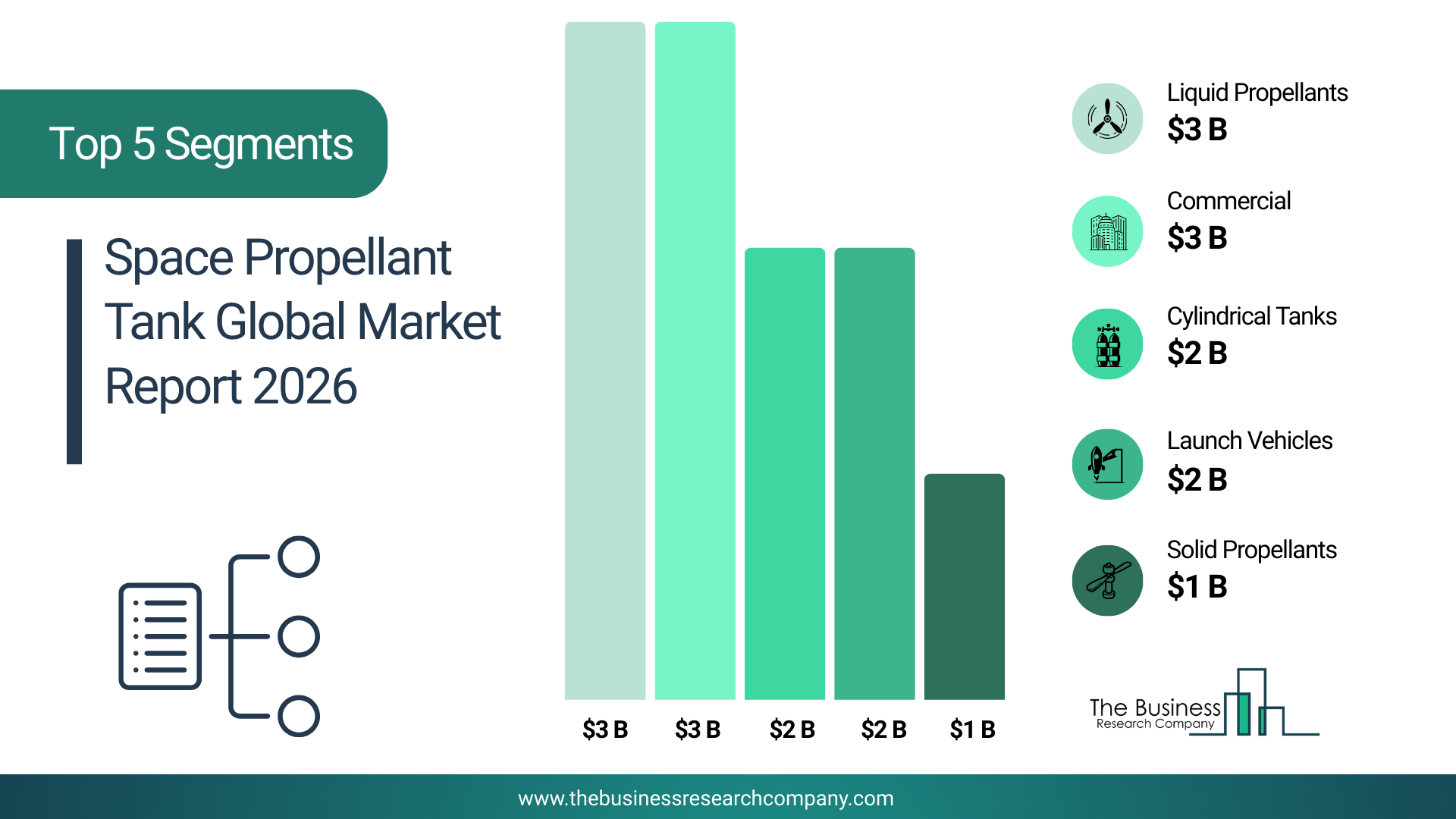
The space propellant tank market is by type into liquid propellants, solid propellants and hybrid propellants. The liquid propellants market will be the largest segment of the space propellant tank market segmented by type, accounting for 68% or $3,415 million of the total in 2030. The liquid propellants market will be supported by higher thrust efficiency enabling heavy-lift missions, increasing deployment of cryogenic propulsion in modern launch vehicles, rising need for precise throttle control in orbital maneuvers, growing use in reusable rockets requiring refuellable tanks, expanding satellite launches demanding high-performance fuel systems, increasing deep-space probes using liquid propulsion for long-duration burns, and advancements in propellant management devices improving safety and stability.
The space propellant tank market is segmented by material into aluminum and titanium alloys, carbon fiber, nanomaterials, stainless steel and thermoset and thermoplastic. The carbon fiber market will be the largest segment of space propellant tanks market segmented by material, accounting for 37% or $1,872 million of the total in 2030. The carbon fiber market will be supported by increasing demand for ultra-lightweight structures for fuel-efficient launches, rising adoption in composite overwrapped pressure vessels (COPVs), expanding applications in reusable rockets that need high fatigue resistance, advances in filament winding improving structural uniformity, growing commercialization of private launch companies seeking mass reduction, increasing compatibility with cryogenic propellants, and improved cost efficiency as carbon composites scale globally.
The space propellant tank market is segmented by tank design into cylindrical tanks, spherical tanks, toroidal tanks and custom designed tanks. The cylindrical tanks market will be the largest segment of the space propellant tanks market segmented by tank design, accounting for 53% or $2,653 million of the total in 2030. The cylindrical tanks market will be supported by simple structural geometry enabling low-cost mass production, increasing use in both solid and liquid propulsion systems, growing preference for ease of integration in launch vehicles, rising adoption in small satellites requiring compact fuel storage, reliable stress distribution improving safety, expanding use in modular propulsion units, and compatibility with established manufacturing and testing methods.
The space propellant tank market is segmented by application into launch vehicles, satellites and spacecraft, orbital transfer vehicles and deep space missions. The launch vehicles market will be the largest segment of the space propellant tank market segmented by application, accounting for 45% or $2,228 million of the total in 2030. The launch vehicles market will be supported by increasing global satellite launches, rising demand for heavy-lift and reusable rockets, expanding commercial spaceflight programs, growth in national space agency missions, higher need for reliable high-capacity fuel storage, advancements in cryogenic propulsion systems, and increasing investment in private launch startups.
The space propellant tank market is segmented by end-user into commercial and defense. The commercial market will be the largest and fastest segment of the space propellant tank market segmented by end-user, accounting for 70% or $3,494 million of the total in 2030. The commercial market will be supported by rapid growth of private launch companies, increasing deployment of mega-constellations, rising demand for cost-efficient propulsion systems, growing investment in space tourism ventures, expansion of commercial satellite broadband initiatives, higher adoption of reusable launch technologies, and increased competition driving tank material innovation.
What is the expected CAGR for the Space Propellant Tank Market leading up to 2030?
The expected CAGR for the space propellant tank market leading up to 2030 is 7%.
What Will Be The Growth Driving Factors In The space propellant tank Market In The Forecast Period?
The rapid growth of the global space propellant tank market leading up to 2030 will be driven by the following key factors that are expected to reshape spacecraft manufacturing, launch economics, and mission architecture worldwide.
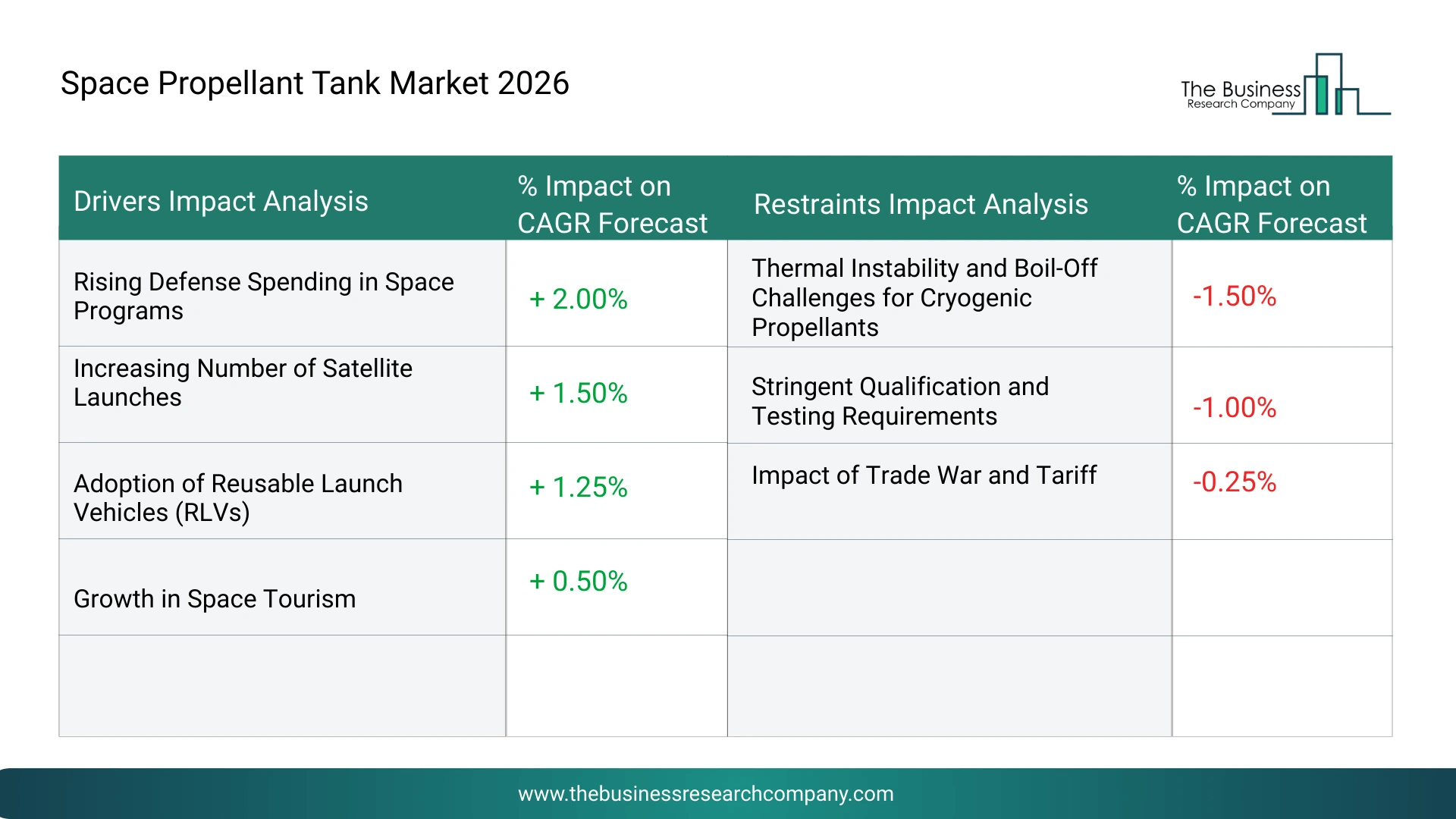
Rising Defense Spending In Space Programs - The increasing defense spending on space programs is expected to drive the growth of the space propellant tank market. Defense agencies are placing greater emphasis on launch systems and spacecraft capable of supporting national security missions, ensuring operational resilience, and maintaining secure and reliable access to orbit, all of which rely on advanced propulsion and fuel storage solutions. Higher investments in defense space initiatives are boosting demand for propellant tanks that provide high durability, stable pressurization, and efficient fuel management to enable mission-critical maneuvers and extended operations. As governments continue to expand funding for launch services, satellite deployments, and space infrastructure, including multibillion-dollar budgets for national security space launches—the need for robust, mission-ready propellant tank technologies is expected to increase significantly, thereby accelerating market growth. As a result, increasing defense spending on space programs is anticipated to contributing to a 2.0% annual growth in the market.
Increasing Number Of Satellites Launches - The increasing number of satellite launches is expected to drive the growth of the space propellant tank market. The increasing frequency of orbital missions requires advanced propulsion systems and reliable propellant tanks to support satellite deployment, precise orbital insertion, and in-orbit maneuvering throughout the spacecraft’s operational life. As commercial satellite constellations, government programs, and scientific missions expand, dependable fuel storage and delivery infrastructure becomes increasingly essential. With satellite launch activity continuing to accelerate, demand for efficient, high-performance propellant tanks capable of accommodating varied launch profiles and mission requirements is set to grow significantly, thereby fueling market expansion. Consequently, increasing number of satellites launches is projected to contributing to a 1.5% annual growth in the market.
Adoption of Reusable Launch Vehicles (RLVs)- The growing adoption of reusable launch vehicles (RLVs) is expected to drive the growth of the space propellant tank market. RLVs lower launch costs and increase mission frequency by allowing rockets to be recovered and reflown multiple times, creating sustained demand for durable propulsion systems and reliable propellant storage solutions. This emphasis on reusability encourages space companies to scale up launch operations and broaden service offerings, placing greater importance on the performance, longevity, and reliability of propellant tanks used across both ascent and recovery phases. As reusable architectures continue to reduce per-launch costs and enable higher flight cadences, demand for advanced propellant tank technologies that support rapid turnaround, efficient fuel handling, and consistent performance will rise significantly, thereby accelerating market growth. Therefore, growing adoption of reusable launch vehicles (RLVs) is projected to contributing to a 1.3% annual growth in the market.
Growth In Space Tourism - The expansion of space tourism is expected to drive the growth of the space propellant tank market. The rise of commercial space travel and growing participation from private individuals and companies are increasing demand for dependable propulsion systems and propellant storage solutions that can support frequent suborbital and orbital missions. Space tourism operations require propulsion and fuel systems capable of safely transporting passengers to space and back, while maintaining stable thrust, effective pressure control, and precise maneuverability throughout each mission. In addition, as operators scale up their flight schedules and passenger volumes increase, the need for advanced and reliable propellant tank technologies becomes more critical. As space tourism continues to mature and flight frequency rises, demand for high-performance propellant tanks designed for repeated tourist missions will grow significantly, thereby supporting market expansion. Consequently, expansion of space tourism is projected to contributing to a 0.5% annual growth in the market.
Access the detailed Space Propellant Tank Market report here:
https://www.thebusinessresearchcompany.com/report/space-propellant-tank-global-market-report?utm_source=EINPresswire&utm_medium=Paid&utm_campaign=Mar_PR
What Are The Key Growth Opportunities In The space propellant tank Market in 2030?
The most significant growth opportunities are anticipated in the commercial spacecraft propellant tank market, the space liquid propellant tank systems market, the cylindrical space propellant storage tank market, the carbon fiber space propellant tank market, and the space propellant tanks for launch vehicles market. Collectively, these segments are projected to contribute over $4 billion in market value by 2030, driven by increasing satellite launches, expanding commercial space missions, and the growing adoption of reusable launch vehicles. This growth reflects rising investments in space exploration and private spaceflight programs, along with the need for lightweight, high-pressure, and cryogenic-compatible storage solutions, accelerating technological advancements across the broader space propulsion infrastructure industry.
The commercial spacecraft propellant tank market is projected to grow by $1,185 million, the space liquid propellant tank systems market by $970 million, the cylindrical space propellant storage tank market by $755 million, the carbon fiber space propellant tank market by $598 million, and the space propellant tanks for launch vehicles market by $526 million over the next five years from 2025 to 2030.
The Business Research Company (www.thebusinessresearchcompany.com) is a leading market intelligence firm renowned for its expertise in company, market, and consumer research. We have published over 17,500 reports across 27 industries and 60+ geographies. Our research is powered by 1,500,000 datasets, extensive secondary research, and exclusive insights from interviews with industry leaders.
We provide continuous and custom research services, offering a range of specialized packages tailored to your needs, including Market Entry Research Package, Competitor Tracking Package, Supplier & Distributor Package and much more
Disclaimer: Please note that the findings, conclusions and recommendations that TBRC Business Research Pvt Ltd delivers are based on information gathered in good faith from both primary and secondary sources, whose accuracy we are not always in a position to guarantee. As such TBRC Business Research Pvt Ltd can accept no liability whatever for actions taken based on any information that may subsequently prove to be incorrect. Analysis and findings included in TBRC reports and presentations are our estimates, opinions and are not intended as statements of fact or investment guidance.
The Business Research Company
Americas +1 310-496-7795
Europe +44 7882 955267
Asia & Others +44 7882 955267 & +91 8897263534
Email: info@tbrc.info
Oliver Guirdham
The Business Research Company
+44 7882 955267
info@tbrc.info
Visit us on social media:
LinkedIn
Facebook
X
Legal Disclaimer:
EIN Presswire provides this news content "as is" without warranty of any kind. We do not accept any responsibility or liability for the accuracy, content, images, videos, licenses, completeness, legality, or reliability of the information contained in this article. If you have any complaints or copyright issues related to this article, kindly contact the author above.
